

Research Overview
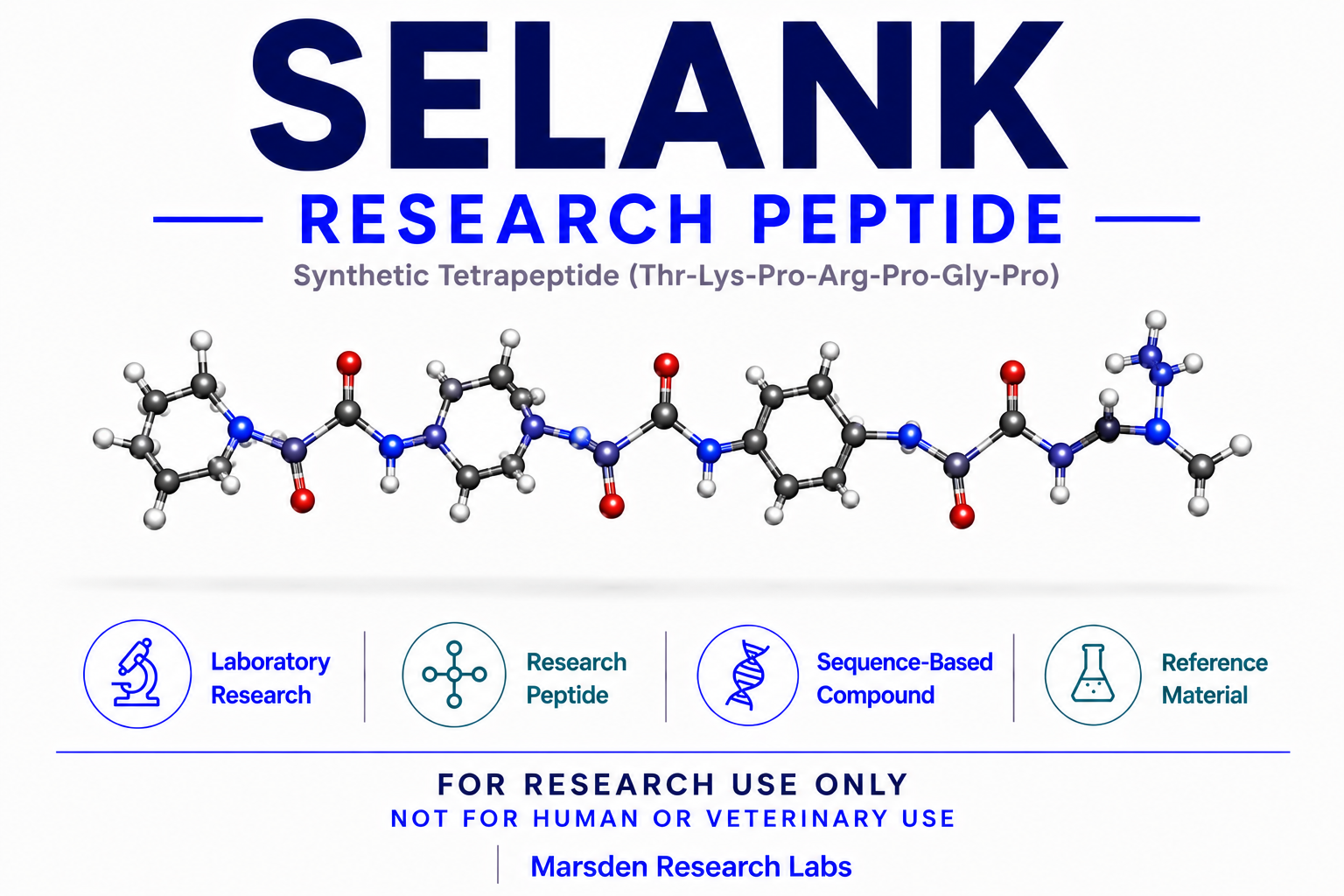
Selank is a synthetic heptapeptide composed of the sequence Thr-Lys-Pro-Arg-Pro-Gly-Pro. Its N-terminal Thr-Lys-Pro-Arg sequence corresponds to the endogenous regulatory peptide tuftsin, with a C-terminal Pro-Gly-Pro extension.
Selank is investigated in laboratory systems involving GABA-associated signaling, neuropeptide biology, neurotransmission-related gene expression, glyproline peptide signaling, and peptide-mediated cellular regulation. Its precise molecular mechanisms remain an active area of investigation.
Selank is not FDA-approved for human use. This material is supplied by Marsden Research Labs exclusively for qualified laboratory research applications and is not offered for human or veterinary use.
Chemical Information
| Compound Name | Selank |
| Compound Type | Synthetic heptapeptide |
| Peptide Family | Tuftsin-derived glyproline peptide |
| Length | 7 amino acids |
| Chemical Formula | C33H57N11O9 |
| Molecular Weight | Approximately 752 g/mol |
| Amino Acid Sequence | Thr-Lys-Pro-Arg-Pro-Gly-Pro |
Physical Characteristics
| Appearance | White to off-white lyophilized material. |
| Solubility | Solubility characteristics depend on concentration, pH, formulation, and laboratory conditions. |
| Storage | Store under appropriate laboratory conditions with protection from unnecessary heat, moisture, and light exposure. |
| Stability | Stability depends on the characteristics of the research material and may be affected by storage temperature, moisture, light exposure, solution conditions, repeated freeze-thaw cycles, and laboratory handling. |
Analytical Verification
Every batch made available for purchase by Marsden Research Labs is supported by current, batch-specific third-party laboratory documentation. Products are not made available for purchase until applicable testing and Certificate of Analysis (COA) documentation are complete. Additional independent laboratory reports may be published for a batch when available.
| Identity Verification | May include Liquid Chromatography–Mass Spectrometry (LC-MS) or comparable analytical methods. |
| Purity Analysis | May include High-Performance Liquid Chromatography (HPLC) or other analytical methods appropriate to the individual sample. |
| Quantitative Analysis | May include quantitative assessment appropriate to the individual batch and analytical method. |
| Batch Traceability | Research batches are assigned unique batch identifiers corresponding to their applicable analytical results and documentation. |
| Certificate of Analysis (COA) | Required for every batch made available for purchase and reflects the analytical results associated with that batch. |
| Laboratory Report | Additional independent laboratory reports may be published for a batch when available. |
Batch-Specific Information
The batch number, analytical results, testing date, Certificate of Analysis (COA), and any additional independent laboratory report displayed near the top of this page correspond to the selected research sample and update automatically when a different batch or package size is selected.
Investigated Molecular Mechanisms
The molecular mechanisms associated with Selank remain under investigation. Experimental studies have examined Selank in relation to GABAergic signaling, including interactions affecting GABA-associated receptor binding and neurotransmission-related cellular pathways.
Gene-expression studies in experimental models have also investigated changes in transcripts associated with neurotransmission following exposure to Selank. These findings have led researchers to examine possible relationships between Selank, GABAergic signaling, and broader neuropeptide-mediated regulatory networks.
Because Selank contains a Pro-Gly-Pro-containing glyproline sequence, it also provides an experimental model for investigating short regulatory peptides, peptide stability, and structure-function relationships within tuftsin-derived peptide systems.
Current Areas of Research
- GABA-associated signaling pathways
- Neuropeptide signaling
- Neurotransmission-related gene expression
- Glyproline peptide biology
- Tuftsin-derived peptide structure-function relationships
- Peptide-receptor interactions
- Short regulatory peptide signaling
Marsden Research Labs makes no representation regarding clinical outcomes or therapeutic applications.
Laboratory Handling
This material should be handled only by qualified laboratory personnel using appropriate research procedures.
Research samples should be stored and handled according to accepted laboratory practices appropriate to the research material. Material integrity may be affected by temperature, moisture, light exposure, solution conditions, repeated freeze-thaw cycles, and handling methods.
Research Use Notice
This product is supplied exclusively for laboratory research purposes.
It is not intended for human or veterinary use, diagnosis, treatment, cure, prevention of disease, food use, cosmetic use, or consumption of any kind. Purchasers are responsible for ensuring compliance with all applicable laws and regulations governing the acquisition and use of research materials.
Reviews
There are no reviews yet.